The late 1980s and early 1990s represented one of the most creatively turbulent eras in Uncanny X-Men history. From issues 220 to 280, the team was pushed to their limits, facing death, displacement, and total reinvention. By running a text analysis on the cover dialogue, captions, and narrative locations from this 60-issue run, we can quantitatively map the thematic shifts that defined this legendary era of Marvel Comics.
Components Introduction
This project focuses on two thing, the Cover Artists and the Interior Locations. By mapping the relationship between who drew the cover and where the story actually took place, this project aims to visualize how specific creators were utilized for distinct eras and settings within the ongoing narrative. I used OpenRefine for data cleaning and RAWGraphs for relationship graphing.
Sources
The crowdsourced files: uncanny-xmen-220-280-covers.csv and uncanny-xmen-220-280-locations-csv.csv.
Significant data cleaning was required to prepare these datasets for visualization, which was handled entirely within OpenRefine:
Data Merging: The two datasets were joined based on their shared “Issue #” column, creating a dataset that directly map each issue’s primary cover artist to its corresponding interior locations.
Clustering & Typo Correction: OpenRefine’s text clustering algorithms were used on the “Cover Artist(s)” column to identify and merge inconsistencies (e.g., cluster the Emipire state building with Empire State Building).
The Mutant Map: Displacement to the Outback
Perhaps the most interesting data point comes from analyzing the locations where these narratives unfold. Traditionally, the X-Men are anchored to their Mansion in New York. However, the location frequency data for issues 220-280 tells a story of total displacement.
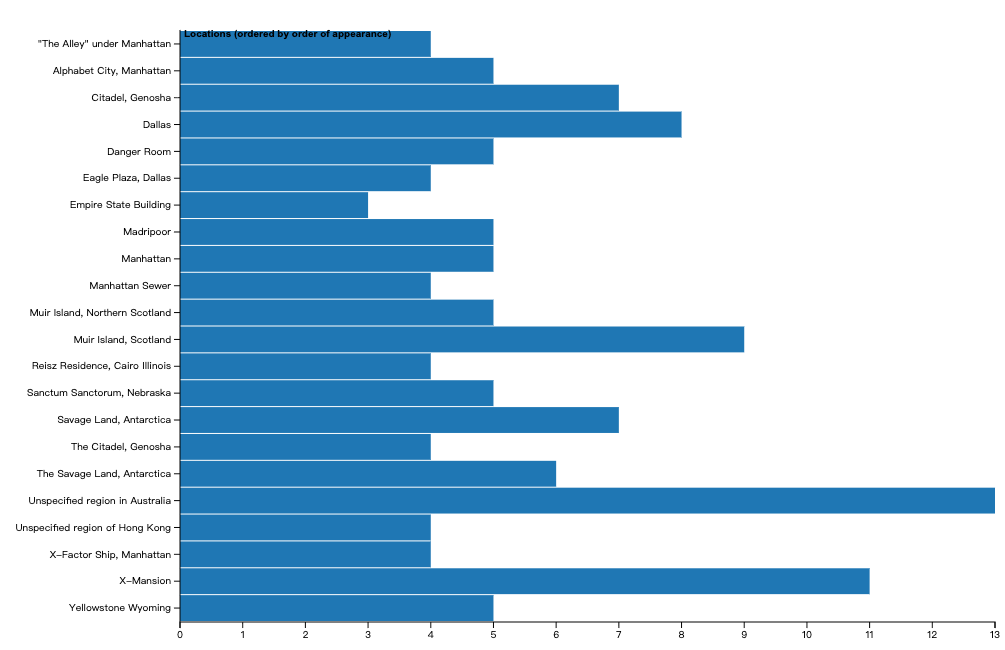
Unspecified region in Australia.The single most frequent location is an “unspecified region in Australia.” Following their apparent deaths in Dallas, the team went completely underground, hijacking a Reavers base in the Outback. The data perfectly reflects this massive shift.
Muir Island, Scotland (9 Mentions): As the secondary hub while the main team was presumed dead, Moira MacTaggert’s mutant research facility became the center, and eventually in the Muir Island Saga.
Dallas (8 Mentions): The site of the Fall of the Mutants climax, Dallas appeared as a frequent location due to its narrative weight as the place where the world watched the X-Men die.
Genosha (7 Mentions): The introduction of the Genoshan Citadel marks the rising geopolitical themes of mutant enslavement and apartheid that would define the franchise for the next decade.
The Visual Architects: Mapping Eras to Artists
Traditionally, comic artists might rotate randomly or due to simple scheduling constraints. However, the cover artist frequency data for issues 220-280 tells a story of highly specific narrative assignments.

- Marc Silvestri (28 Covers): The single most frequent cover artist in this span. Silvestri was the defining piece for the Fall of the Mutants and the subsequent Outback Era. His covers almost is the X-Men’s darkest days itself.
- Jim Lee (18 Covers): Lee’s covers saw the X-Men pushed out of the dust and into wildly exotic, sci-fi environments. A massive portion of his covers are with issue that set deep in the hidden jungles of the Savage Land or the high-tech mutant laboratories of Muir Island, settings perfectly suited to his highly detailed, explosive art style.
- Rick Leonardi (4 Covers): Brought in for darker or highly specialized narrative arcs, Leonardi’s covers heavily index against specific, hostile environments, most notably the demonic dimension of Limbo and the oppressive, mutant-enslaving citadel in Genosha.
Conclusion: Visualizing the Era
The relational data between the cover artists and interior locations from issues 220-280 paints a quantitative picture of a comic book in massive transition. Between the dramatic shift away from the traditional New York mansion to the Australian Outback and the Savage Land, the data confirms a highly deliberate editorial strategy: Marvel didn’t just cycle cover artists at random; they assigned distinct visual architects to specific geographic eras. Marc Silvestri perfectly captured the gritty survivalism of the team’s exile, while Jim Lee illustrated their explosive return to sci-fi prominence. Ultimately, the data confirms that this legendary era of the X-Men was defined as much by who drew the covers as where the stories took place.